Designing for minimal N₂O emissions at the new Kalmarsundsverket - Water Recycling Plant (Sweden)
Kalmar Vatten used AM-Team’s AMNOXA™ modelling to design the new Kalmarsundsverket Water Recycling Plant for minimal N₂O emissions, improved treatment efficiency, and future monitoring readiness.
Case highlights:
- A ‘minimal N2O by design’ approach was adopted to minimize carbon footprint in design stage of a new treatment facility
- The AMNOXATM model visualized plant performance and N2O hotspots in 3D and revealed two dominant N₂O formation risks in the new plant’s designs
- Based on the modelling outcomes, critical design elements were adjusted: baffling wall modification, external carbon dosing location and aeration strategies
- Plant efficiency was maximized in parallel with N2O minimization
- Model outcomes will also be used for determination of future N2O monitoring spots
Authors

Introduction and problem statement
The Swedish water utility Kalmar Vatten is building Sweden's leading urban recycling plant—Kalmarsundsverket—as part of their mission to perform advance treatment of municiple wastewater and become climate-neutral while raising the status of water infrastructure. Beyond treating wastewater, this innovative facility will produce recycled water for future use in irrigation and industry, produce certified soil improvers, and generate biogas for heat and electricity. For Kalmar Vatten, addressing greenhouse gas emissions in the design stage represents a crucial step toward climate neutrality, as process emissions significantly impact their carbon footprint.
Kalmar Vatten engaged AM-Team to integrate minimal nitrous oxide (N₂O) emissions into the design phase of their new Kalmarsundsverket wastewater treatment plant. The goal was to understand N₂O formation mechanisms across different design variants and identify optimal bioreactor configurations that would minimize emissions while maximizing treatment efficiency—embodying the principle of 'minimal N₂O by design.' AM-Team worked closely together with the equipment provider (Xylem) and engineering firm (Eliquo Malmberg Water) to find the feasible and effective mitigation solutions.
"AMNOXATM enabled us to test a multitude of design scenarios. We could see the exact effect of how different mixing options, aeration strategies, and carbon dosing locations would affect N₂O formation and plant performance.” - Dr. Qing Zhao, Process and Development Engineer, Kalmar Vatten
Solution and Objectives
The forward-thinking digital engineering approach allowed virtual testing of multiple design configurations which are impossible to evaluate on-site in a non-existing plant. Optimal use of the model insights would reduce emissions and improve efficiency from day one of operation.
The objectives were to:
- Understand N₂O formation mechanisms in the new bioreactor designs
- Optimize mixer and aeration placement to minimize N₂O production
- Test and compare mitigation strategies for various design options
- Determine optimal N₂O sensor locations for future monitoring
- Integrate efficiency improvements alongside emission reductions
Approach
AM-Team's AMNOXATM modelling framework was used for comprehensive 3D assessment of the new plant. AMNOXATM relies on specialised treatment data handling and a mixture of 3D and dynamic modelling. The 3D model, used in this project, consists of a physics-based Computational Fluid Dynamics (CFD) model with integrated biokinetics. Nutrient and carbon conversion and N2O production, transport and stripping are realistically taken into account.
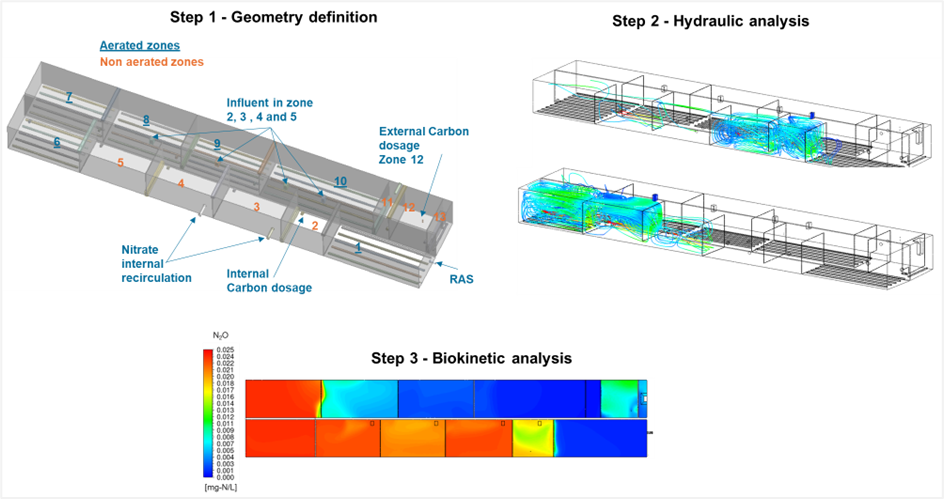
The modeling approach (Figure 1) included:
- Detailed reactor geometry including all zones, inlets, outlets, mixers, and diffusers
- Design data for two scenarios: 2027 commissioning conditions (18,000 m³/d) and 2050 future capacity (27,000 m³/d)
- Hydrodynamic analysis to identify mixing patterns and potential backflow issues
- N₂O hotspot and root cause analysis pinpointing the local drivers for N2O production
- Virtual testing of mitigation scenarios including influent distribution, aeration strategies, and carbon dosing optimization
“The 3D hotspot analysis is one of the key features of AMNOXATM, allowing to optimize biological treatment plants in a very effective manner." - Dr. Giacomo Bellandi, Tech Lead, AM-Team
Results and Findings
Root Cause Analysis: understanding N₂O formation mechanisms
AMNOXATM revealed the specific biochemical pathways driving N₂O formation in the new reactor design. As shown in the N2O heatmap in Figure 2, two primary mechanisms creating local ‘N2O production hotspots’ were identified:
AOB Denitrification: At the start of aerobic zones, low dissolved oxygen (DO) combined with high ammonia levels would trigger ammonia-oxidizing bacteria (AOB) to produce N₂O through the denitrification pathway 1. This was particularly evident in zones (Figure 1) where the transition from anoxic to aerobic conditions created a zone where DO levels struggled to reach setpoint quickly, providing ideal conditions for this pathway.
Heterotrophic Denitrification: In anoxic zones where the carbon/nitrogen (C/N) ratio was suboptimal, incomplete denitrification led to N₂O accumulation as an intermediate product 2. The initial design showed incomplete denitrification particularly in zones where external carbon dosing had not yet been fully mixed and utilized by heterotrophic bacteria, creating hotspots of N₂O production.

“AMNOXATM is a solution that uniquely allows 'minimal N₂O by design'. This is crucial, as there is no monitoring data available in the design stage, but important decisions still need to be made. We wanted to achieve a design that had minimal N2O baked in." - Dr. Qing Zhao, Process and Development Engineer, Kalmar Vatten
Design Optimization: Minimal N₂O by Design
The power of minimizing N2O in the design stage became clear when testing various reactor configurations. Each design modification could be evaluated for its impact on both N₂O formation and overall plant efficiency:
Mitigating undesired backflows: Hydrodynamic analysis revealed significant backflows in some anoxic zones. The model revealed that adjusting mixer orientation or baffle walls could potentially reduce backflows by 70-80% without compromising mixing efficiency. This design change improved flow patterns and minimized risk of undesired oxygen recycling to anoxic zones, which would have exacerbated N₂O production through the AOB denitrification pathway. In the end, the project consortium selected the baffle wall adjustment as most feasible option to implement in the final design.
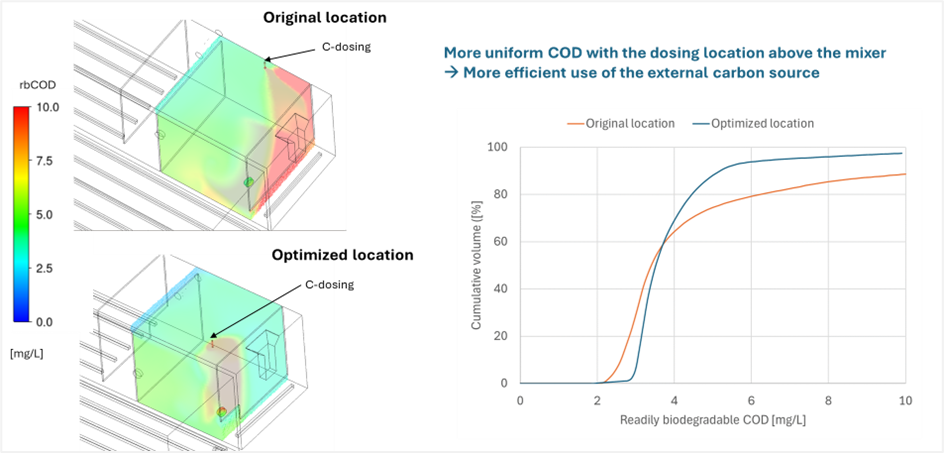
Carbon Dosing Location: Results showed that relocating the external carbon dosing pipe improved C distribution and denitrification completeness (Figure 3). This uniform C distribution —achievable only through virtual testing—improved both N₂O mitigation (by ensuring complete denitrification) and operational efficiency (by optimizing carbon usage).
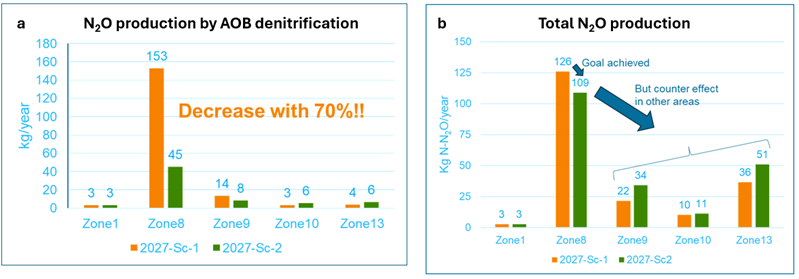
Aeration Strategy: Virtual testing revealed that increasing aeration in the first aerobic zone (zone 8) reduced AOB denitrification activity by 70% (Figure 4a). However, this also increased overall nitrification, leading to higher nitrate levels and subsequent heterotrophic N₂O production in aeration zones. The net impact on N2O was hence negative (Figure 4b). This demonstrated the importance of balanced system design rather than isolated optimizations—a key insight that guided the final recommendations for operational control strategies.
Efficiency Gains and Performance Improvement (3E: Emissions, Effluent, Efficiency)
The design optimizations delivered benefits beyond N₂O mitigation. The principle of 'minimal N₂O by design' inherently led to a more efficient plant:
Improved Mixing Efficiency: Reduced backflows band more uniform mixing patterns were achieved, improving overall treatment kinetics while preventing the oxygen recycling that would have contributed to N₂O formation.
Enhanced Carbon Utilization: Optimizing carbon dosing location improved distribution efficiency, meaning the same amount of external carbon achieved better denitrification results. This translates to potential operational savings through more effective use of carbon sources while simultaneously reducing N₂O emissions from incomplete denitrification.
Better Effluent Quality: The balanced aeration and carbon dosing strategies designed to minimize N₂O also improved nitrogen removal efficiency. Complete denitrification means less nitrate breakthrough and better overall effluent quality—supporting Kalmar Vatten's goal to reduce effluent nitrogen and phosphorus by at least 35% compared to their old plant, while coping with future increasing influent loading.
“AM-Team’s hotspot analysis revealed where and how N2O was likely to be produced. By pinpointing and tackling those root causes, we could mitigate N2O based on a scientifically sound methodology." - Dr. Qing Zhao, Process and Development Engineer, Kalmar Vatten
Sensor Placement for Future Monitoring
Given the complex and dynamic nature of the system with multiple swing aeration zones, the AMNOXATM analysis identified optimal sensor locations for future N₂O monitoring. The modeling revealed that emissions can vary significantly during transitions from anoxic to aerobic conditions and during peak loadings. For comprehensive monitoring, a dynamic model or digital twin approach was recommended to support ongoing optimization during plant operation.
Conclusion and Impact
Kalmar Vatten, the consortium partners Xylem and Eliquo Malmberg Water and AM-Team successfully integrated climate-smart design principles into the new wastewater treatment plant through AMNOXATM modeling. By identifying N₂O formation mechanisms at the design stage, they could optimize reactor configurations before construction—embodying the principle of 'minimal N₂O by design.'
Key achievements include:
- Comprehensive understanding of N₂O formation mechanisms specific to the new reactor design based on a 3D N₂O hotspot analysis
- Practical design optimizations: 70-80% backflow reduction through refinement of partition wall, optimized carbon dosing locations, and balanced aeration strategies
- Identification of critical operational parameters (DO setpoint in first aerobic zone, COD/N ratio optimization) for ongoing N₂O management
- Simultaneous improvements in emissions, effluent quality, and operational efficiency—the 3E approach that supports Kalmar Vatten’s broader circular economy vision
“While N2O often gets attention within existing treatment plants, significant mitigation impact can be made in the design stage prior to construction. AMNOXATM is the only solution that allows minimal N2O by design, in combination with maximizing general plant performance." - Dr. Giacomo Bellandi, Dr., Tech Lead, AM-Team
AMNOXATM allowed to thoroughly evaluate the plant before construction. Kalmar Vatten can now commission their new plant with confidence, knowing it's designed from the ground up to minimize N₂O emissions while maximizing treatment performance and resource recovery. This project establishes a new standard for climate-conscious wastewater infrastructure: designing minimal emissions in, rather than retrofitting solutions later.
---
[1] AOBdenitrification: while AOBs are supposed to nitrify (NH4 + O2à NO2), they can alsocreate N2O under high ammonia, low dissolved oxygen conditions: NO2+ NH4 à N2O(‘AOB denitrification’)
[2] Incompletedenitrification: while heterotrophic bacteria are supposed to denitrifycompletely (NO3 + C à N2), theycan stop at N2O under C limiting circumstances (NO3 + C à N2O)
Contact us
Suggested Projects




Subscribe to our newsletter



